
|
What is the truth behind this statement by a Battle of Britain pilot that during the clashes over the Channel filed claims for a total of four RAF fighters, three Spitfires and a Hurricane, the last on 2 September when he downed a Spitfire over Folkestone at 17:30. This is a comment that does not fit well with the common perception of the turning performance of the Bf 109 E compared to the Spitfire. The common perception is that both the Hurricane and the Spitfire were superior or at least better in terms of turning performance in combat. It is often pointed out from the British side that this advantage was often decisive for the further course of the battle, while other important aspects of the air battles are overlooked, such as climb and dive speed, armament, speed and engine performance at different altitudes. One comment regarding this comment view suggests that if the performance of aircraft in combat were so decisive, the Royal Air Force could have been better equipped during the Battle of Britain if they had been equipped with the Italian CR 42, the Soviet Polikarpov I-16, or even the British Gloster Gladiator. All of these aircraft possessed superior turning performance compared to both the Spitfire and the Hurricane. What is the fact regarding the Bf 109 E and the Spitfire regarding true turn-performance in combat? Please listen to my cousin Anders Johnsson's research. Anders, who is renowned aerodynamics that have used the latest technology when it comes to his analysis, now published on YouTube. In October 1940, the German Supreme Command was forced to admit the failure of the planned annihilation of the RAF. Losses were very high on both sides. The true loss figures of the Battle of Britain are being discussed even to this day. The statistics given by Winston Churchill in his war memoirs shortly after the war served as the main reference point for several years. According to this source, two German aircraft were shot down for every British fighter lost. Recent research, however, has come up with different figures. The RAF loss table, inexplicably absent in Churchill's detailed memoirs, shows the loss of 1,671 aircraft destroyed in combat, plus 995 badly damaged, during the period July 10 - October 31, 1940. Corresponding statistics on the German side show Luftwaffe combat losses of about 1,400 aircraft (of which 502 were Bf 109 Es) during the same period.
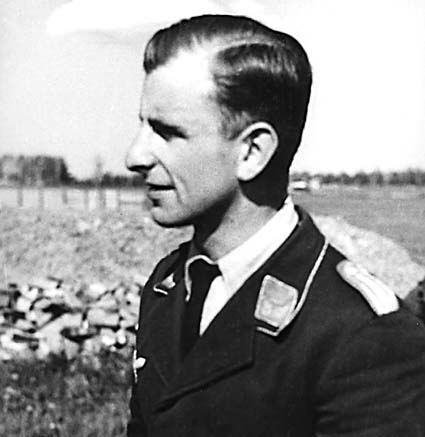
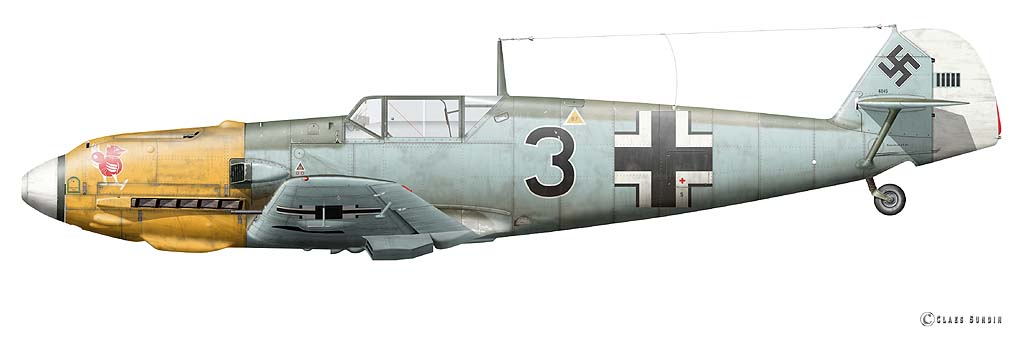
Leutnant Erwin Leykauf
was one of the most notable young officers in JG 54 during the
first years of the war. He was credited with a total of 33 Abshusse,
the major part on the Eastern Front. This profile was published in my Profile Bok No 3 as profile No 11. |
 |
 |
 |
 |
 |
 |