
|
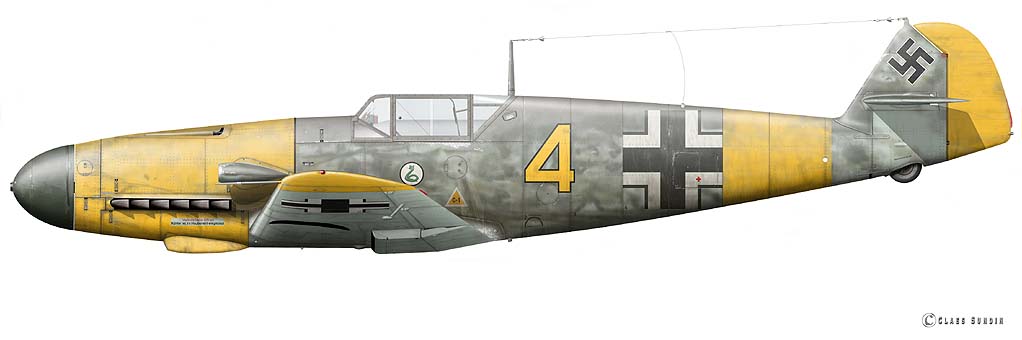
II./JG 52 moved closer to Moscow in early October of 1941, based first at Stabna some 250 km from the Soviet capital. The I. and II. Gruppen then moved 120 km closer to the city arriving at their new base at Dugino on 12 October, to support Panzergruppe 3's trust advance on Kalinin. However, the German forces were hampered by the weather as the onset of winter slowed the advance. Four days later on the 17th, Barkhorn and JG 52 arrived at their new base at Kalinin. Located closer to the front, it was a base well-equipped with permanent quarters, something the Gruppe´s personnel appreciated considering the weather situation. The only drawback was that the airfield was very close to the front and thus under constant Soviet artillery fire. The German offensive had by this time come to a standstill and the Red Army had seized the initiative and managed to break into the German lines. In support of their ground forces, Barkhorn participated in an hour-long mission against enemy troops in the Vyshny-Volochev area where the Gruppe pilots claimed two Abschüsse. The next day on 18 October, the combined force of I. and II. Gruppen flew missions in the same area and claimed eleven VVS aircraft. Oblt. Steinhoff claimed two Pe-2s for his 43rd and 44th Abschüsse, the only claims filed by the II. Gruppe. Up to 28 October the Gruppe mostly flew "freie-Jagd" missions over the Kalinin area where the Gruppe's pilots filed just four additional claims. However on 30 October the Gruppe was forced to leave their base as a barrage of enemy artillery hit eight Bf 109 'Friedrichs', four of them written off as total losses. Forced back and relocating to Stariza base, on the next day, 1 November, Barkhorn finally received some good news that he was promoted to the rank of Oberleutnant. As the German drive towards Moscow continued despite the unfavorable weather conditions the unit followed, this time to Rusa, situated just some 70 km west from the capital city. On the day of their arrival there on 4 November, the men of II./JG 52 received a visit from Oberst Werner Mölders, the inspector of Fighters. This provided a small distraction from a rather dismal situation. On 15 November, Uffz. Bernhard Wilsky while on a ferry flight to Krasnogorsk, piloting Barkhorn's Bf 109 'Yellow 4', was obliged to make a force-landing and remains listed MIA since that date. This machine was later photographed as a war-prize by the Soviets. It is interesting to note that during this whole period Oblt. Barkhorn failed to make any additional claims. It was not until the morning hours of 1 December during a fighter sweep that he downed an I-16 at 10:07 hours for his 10th Abschuss. 'Yellow 4' W.Nr. 12913 was completed by AGO in June 1941. Painted in greys RLM 74/75/76, its fuselage sides had large sprayed patches of RLM 75 followed by a finer irregular pattern of RLM 74. The machine has significant
portions painted in RLM 04 yellow theatre and recognition markings.
The spinner appears to have been overall RLM 70 black-green.
The 4. Staffel's "snake" badge under the cockpit is
the only unit marking displayed. Please note that that this profile and caption would be included in my upcoming profie book No 16 as profile No 29. This book is due to be published in April. |
 |
 |
 |
 |
 |
 |