
|
After another year of fighting "Fips" Philipp could look back to an eventful period lasting from early 1942 to early spring of 1943 where his Gruppe had continued to operate on the Northern sector of the Eastern Front. They were subordinated to Luftflotte 1 under the command of Generaloberst Alfred Keller. A time under which the Gruppe had transitioned from the Messerschmitt Bf 109 F-2 to the upgraded F-4 variant and later the to the G-2 to counter modernizing Soviet fighter models. However, Unlike II. and III. Gruppe which began transitions to the Focke Wulf Fw 190, I./JG 54 predominantly continue to soldier on flying their Messerschmitts into early 1943 to ensure operational continuity during heavy winter defensive battles. Hard battles have been fought as when the Red Army successfully surrounded approximately 100,000 German troops of the II. Armeekorps in the Demyansk region. Despite the conditions, I./JG 54 maintained air superiority over the pocket, allowing the transport fleet to successfully sustain the trapped German forces until a land corridor was reopened. Simultaneously, the Soviet Volkhov Front launched a massive offensive led by General Andrey Vlasov's 2nd Shock Army, attempting to break through German lines and relieve the Siege of Leningrad. From January to July 1942, I./JG 54 pilots racked up massive victories against the VVS. By early 1943, the Soviet military launched Operation Polar Star a coordinated strategic offensive aimed at decisively crushing Army Group North and completely lifting the Siege of Leningrad. Flying out of airfields like Siverskaya, I./JG 54 faced a significantly modernized Soviet Air Force flying newer Lavochkin La-5 and Yakovlev Yak-7 fighters. The air battles over the frozen Ladoga and Volkhov sectors were massive and relentless. While the Red Army managed to open a narrow land corridor to Leningrad (Operation Iskra), the I./JG 54's defensive actions successfully prevented the complete collapse of the German northern front. On a personal level Hptm. Hans "Fips" Philipp became the first member of JG 54 to be awarded the Swords to the Knight Cross. Philipp also became the fourth Luftwaffe fighter pilot to achieve 100 victories. And then despite a brief mandatory flying ban imposed on him after his 100th victory to preserve his life for propaganda purposes, he returned to combat and steadily downed Soviet aircraft through the brutal winter battles. And on 14 January 1943, by downing more adversaries he reached the covered 150-victory mark. Then on his 26th birthday on 17 March 1943, Philipp claimed four Soviet aircraft shot down, pushing his total score to 203 Abschuss. At that moment, this made him the highest-scoring active fighter pilot in the entire Luftwaffe surpassing Hermann Graf, who had reached 200 first but was grounded from combat operations. A promotion to Major
followed in March. On 1 April he was officially transferred from
the Eastern Front and promoted to Geschwaderkommodore of Jagdgeschwader
1, tasked with the Defense of the Reich against Allied daylight
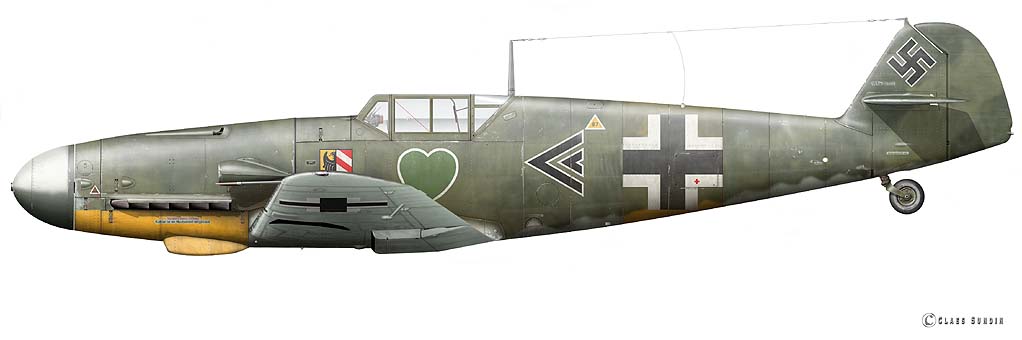
bombing raids. Note this machine with its typical for JG 54 two-tone
green camouflage. Note also that the only yellow theatre recognitions
markings were painted on the engine cowling underside, also the
installed wing camera under its left wing. This profile is one of the 130 Luftwaffe fighters included in my latest profile book No 52. |
 |
 |
 |
 |
 |
 |