
|
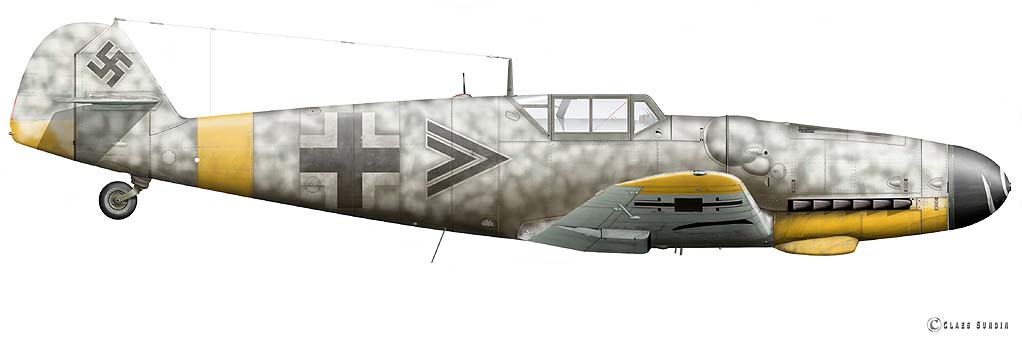
Siegfried Schnell was one of the leading pilots flying over the channel front. One of the pilots that introduced the frontal-attack on the USAAF 4-engine bombers. However after that his scoring rate slowed down as he focussed more on administration and command, and he led his unit in the changeover onto the new Fw 190. In a misguided idea by High Command to rotate the fighter Gruppen between Western and Eastern Fronts, III./JG 54 was transferred from the Eastern Front back to Germany for Home Defense. Hauptmann Schnell, was given command of the unit on 1 May 1943 to train and lead the pilots in high-altitude interception rather than the low-level brawling they were used to on the Eastern Front. He had taken command of the Gruppe from Major Reinhard Seiler. And on 11 January 1944, the "Eastern front flyers" of the III. Gruppe ole their first interception against a raid flown by the USAAF resulting in eleven B-17 shot down, including three by Schnell. On 1 February 1944, he was given command of IV. Gruppe of JG 54, based near Leningrad, and he arrived on 11 February. He replaced Hauptmann Rudolf Sinner. As mentioned above, command transfers between fronts were rare, given the markedly different combat conditions. And during the Battle of Narva the Luftwaffe in an effort to prevent a total collapse of the northern flank, the Luftwaffe rushed in reinforcements. As a consequence, on 1 February 1944, Siegfried Schnell arrived on the Leningrad front to take over command of IV./JG 54, the opponents on the airfields in the Leningrad vicinity included men such as Major Pokryshev with 38 plus 8 shared kills and Captain Likholetov (25 plus 5 kills), both from 159th Fighter Regiment, as well as Chirkov (29 plus 9) and Zelenov (24 plus 10) of 29th Guards Fighter Regiment. By late February 1944, the Soviet Red Army had broken the Siege of Leningrad and rapidly pushed the Wehrmacht back to the Estonian border. The Soviet Narva Offensive sought to breach the German "Panther Line" along the Narva River. Unfortunately Schnell was not lucky to be able to adapt quickly enough. After less than a month and three further aerial victories he would fly his last combat mission. On the morning of 25 February the Soviet Air Forces launched massive tactical bombing loops and ground-attack sweeps south of the city of Narva to support Red Army infantry trying to expand bridgeheads across the river. Hptm. Schnell led a formation of Messerschmitt Bf 109 G-6s to intercept the incoming Soviet strike. The Germans ran directly into a thick, aggressive screen of Soviet escort fighters, primarily Yak-9s and La-5s, that was protecting the low-flying ground-attack formations. n the following clash Hptm. Siegfried Schnell Bf 109 G-6 was hit, possibly by one of those mentioned abowe, His aircraft slammed into the terrain near Narva, killing him instantly. Posthumously, he was
promoted to Major in the Reserves. In all Siegfried Schnell was
credited with 93 confirmed victories, 90 of them against the
western Allies, including 12 four-engine bombers. This Erla built
G-6 had a overspray consisting of white blotches with full Eastern
front theatrical markings and a thin white spiral on the Black
spinner. This profile is one of the 130 Luftwaffe fighters included in my latest profile book No 17. |
 |
 |
 |
 |
 |
 |