
|
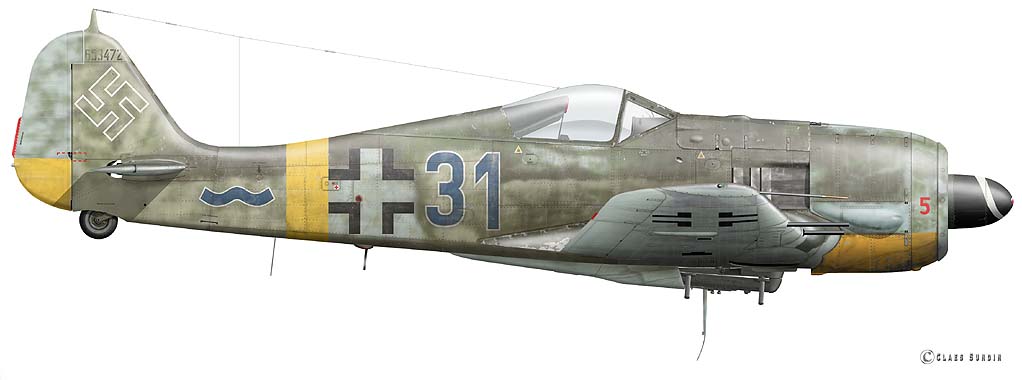
On April 2, 1945, First Lieutenant Carr was leading three other aircraft on a reconnaissance mission near Schweinfurt, when he spotted 60 German fighters flying above them. Despite the enemy having an altitude advantage and outnumbering them, Carr led his flight in an attack and the pilots downed a total of 15 aircraft. Carr personally shot down two Fw 190s, three Bf 109s and damaged a sixth fighter. This feat made Carr the last ace in a day in the European Theater during the war. A week later, on 9 April 1945 Carr was promoted to Captain and claimed several more aerial victories that month, claiming two final victories on 25 April. However after the war the story of Bruce Carr "stealing" an Fw 190 and escaping from behind enemy lines was told. According to the myth, "On 2 November 1944, Carr took off on a mission and was shot down by flak while strafing ground targets over Czechoslovakia. He bailed out and landed near a Luftwaffe field with the intent of surrendering to the Luftwaffe troops, but it was becoming dark just as he got there. From the trees he watched as two mechanics fueled up an FW 190, and hatched a daring plan to escape by stealing that plane. Near dawn he sneaked out and jumped in the cockpit. Through experimentation, Carr was able to start the plane, and with Luftwaffe personnel already coming out to see what was going on he gunned it across a corner of the field on a path that had him pass between two hangars before he was airborne. Here, the garbled tell returns to reflecting actual historical events. "Managing to make it back to his home field in France, Carr was unable to lower the landing gear and was forced to make a belly up landing. The truth is that, like many pilots after the war, Bruce Carr wanted to fly a German plane. Carr hitchhiked to Linz in Austria in early May 1945, where he chose the Fw 190 A-6/A-8 hybrid, "Blue 31" for his mount. After flying back to Ansbach with an escort of 354th FG P-51s, Carr couldn't get the 190's gear down and was forced to belly land it on the grass at Ansbach. Post-crash photos of Carr show him walking around unhurt and wearing a neat, clean uniform, hardly the look of someone who had just evaded capture and flown a stolen Focke Wulf to freedom. Shortly before his death in 1998, at the AFAA Annual Reunion in San Antonio, this incident was brought up in front of Colonel Carr and many others from his unit and he admitted/accepted that it was a "bar story that got out of hand. Capt. Bruce W. Carr flew a total of 172 combat missions during the war, accumulating 15 confirmed air-to-air victories. He had several more unconfirmed victories and multiple ground kills. This "stolen" "Blue 31" is a well documented machine bellied at Ansbach by Carr was original flown in 4./EKG(J) - Ergängzungkampfgeschwader (Jagd)/ replacement training bomber wing (fighter). This is a hybrid aircraft, an A-6 upgraded to A-8 status but with the MG cowling the A-6 type. The Hakenkreuz is the white outline type and along with the fuselage Balkenkreuz style that might be a clue to determining the Werknummer block. It is certainly a recycled
aircraft. This Fw 190 A was originally stationed at Pilsen, Czechoslovakia.
From there, it was invariably flown to the west ahead of the
Russian advance, being abandoned at Linz, Austria. This Fw 190 A-8 flown by Lt. Neitzke would be published in my next profile book, Profile book No 16, due to be published in March/April 2026. |
 |
 |
 |
 |
 |
 |