
|
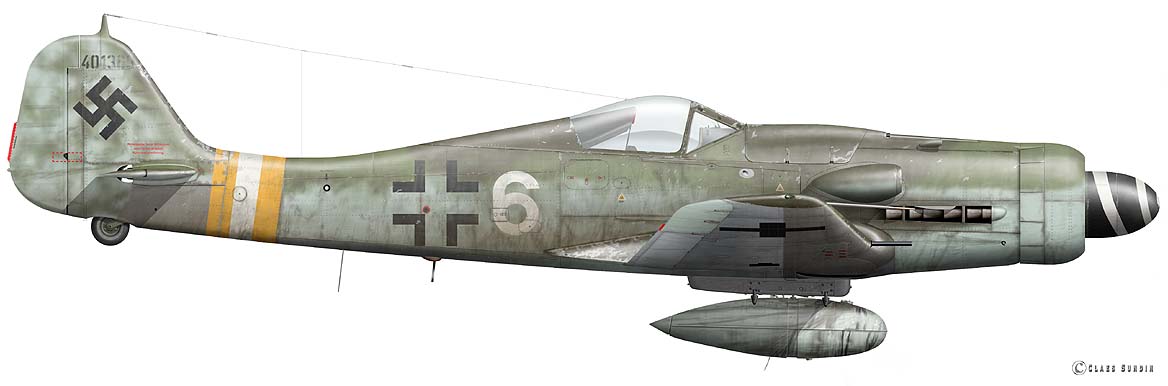
On this day, the first day of spring 1945, JG 2 continued its ground attacks in the Bad Kreuznach/Grünstadt area, particularly targeting the autobahn southwest of Grünstadt. Eighteen Fw 190s led by Hptm. Hrdlicka took off from Grünstadt at 7:12 a.m., and almost simultaneously aircraft of III./JG 2 took-off from Nabenhausen. Both Gruppen returned to their respective airfields around 09:00. A second mission (fighter-sweep) was flown by the I. Gruppe later that day, also led by Hptm. Hrdlicka. The Gruppe intercepted a group of enemy fighters and during the ensuing dogfight Fw. Otto Kleinert Dora's engine was hit, forcing him to belly-land his 'White 6' near Mannheim-Sandhofen. JG 2's daily report mentions one P-47 "Definitely" and another two "probably" destroyed. Fifteen days later on 7 April Otto "Struppi" Kleinert would belly-land yet another Dora. On that day, 12 D-9s from I/JG 2 took-off from Schalfstädt at 06:20 to attack vehicles in the Langensalza-Mühlhausen-Halberstadt area. However, not a single engagement was reported, but two pilots had to land at another airfield. Between 08:10 and 09:13 hours, a similar operation took place with six aircraft against targets on the road between Eisenach and Langensalza. The Focke Wulfs were then involved in a skirmish with 354th Fighter Group P-51 Mustangs over Querfurt starting around 10:00 a.m. The Americans ultimately claimed five German fighters shot down but it also led to the loss and capture of 1st Lt. L.E. Bater. Recalling the event, Fw. Otto "Struppi" Kleinert's had a similar experience but came off better: "I found myself in the middle of a group of Mustangs, from whom I tried to escape with a somersault and a dive. I regained control of my aircraft near the ground and attempted to escape at low altitude. But, just when I thought I had lost my pursuers, I glanced back and saw the red nose of a Mustang approaching. We engaged each other at very low altitude. After three maneuvers, I was behind it in an excellent firing position. But pressing the trigger didn't elicit the slightest reaction from my weapons, my cannons remained silent. The Mustang pilot was very lucky that I let him get away. As soon as he was gone, my engine cut out. I quickly spotted a field long enough to allow my D-9 to make a wheels-up landing. I moved away as quickly as possible, fearing that the Americans would fire on me." The P-51 claimed this day (Bater's) was filed by Ogrf. Wojacek for his first Abschuss. Otto "Struppi" Kleinert is credited with three confirmed victories, all of them claimed during the spring months of 1943; one Spitfire and two B-17s. No more official claims submitted by him have been found, although he as a capable pilot taking part in two more years of combat missions. One of the reasons could be that by the end of the war very few of the filed claims made by JG 2 mentioned the successful pilots. From its camouflage scheme and markings style 'White 6' is most likely a machine from a small group of 50 D-9s produced by Arbeitsgemeinschaft Weserflug (Arb. "Roland" / "MDL"), over the December 1944 to February 1945 period (W.Nr. 401351-401400). Camouflag e follows the generic Focke Wulf pattern of RLM 81/82 brown-violet/light green with RLM 76 blue-grey undersides. The main wing underside are a combination of RLM 75 grey (forward half) and the remainder left in natural metal. The ailerons were finished in RLM 76 though the flaps were left in bare metal. Note the unusually narrow JG 2 yellow-white-yellow Geschwader fuselage band. This profie was published in my Profile book No 16 as profile No 107. |
 |
 |
 |
 |
 |
 |