
|
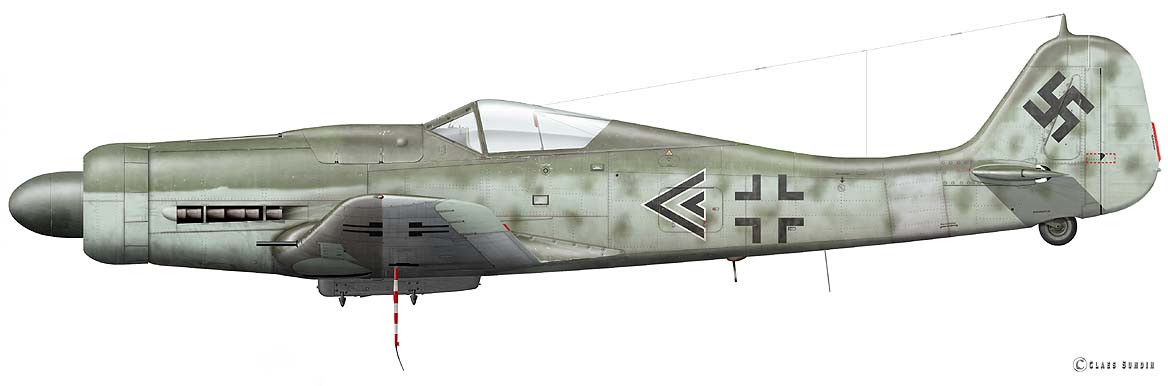
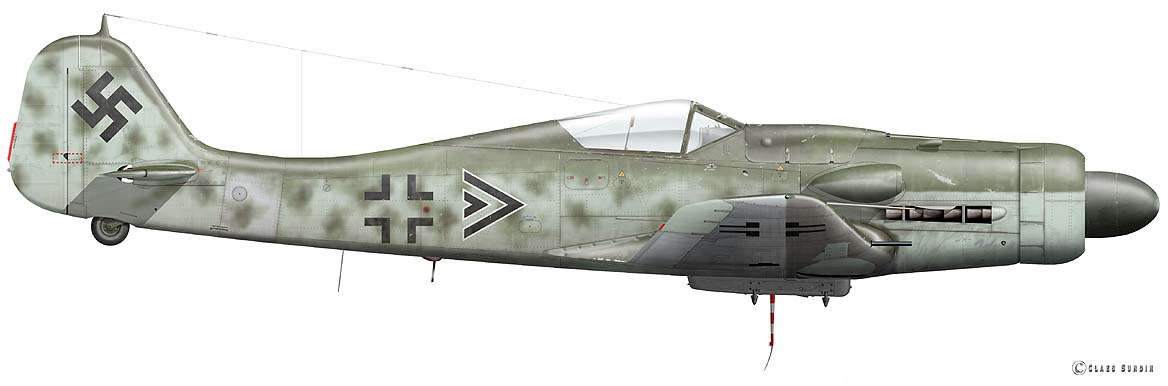
A question I often get from my book buyers is why I don't portray a specific aircraft from both sides and why not the top and bottom of the same plane. The simple explanation is that as a profile artist I want to keep speculation to a minimum and if there is no access to photo documentation I simply don't do these profiles. Of the over 3 000 profiles I have done to date, all of these can be confirmed by photographs, unfortunately the melancholy fact is that very rarely are these machines so well documented that you have access to photos from both sides of the airframe, and even more unusual is that you have any form of documentation of the bottom and top of a specific aircraft. In fact, only 50-70 of the 3 000 aircraft I have profiled to date are portrayed from both sides, and even fewer of their bottom and top sides. Anyway, I have by now gone through my old Fw 190 D-9 profiles and can state that seven of these can be defacto confirmed on both sides. One of these machines is this machine that was flown by Oskar "Ossi" Romm. Although of Jewish decent, and classified as a "Mischling" under the National Socialist's Nürnberg laws, Oskar "Ossi" Romm joined the Luftwaffe in 1939 and trained as a fighter pilot from July 1941 to August 1942. On 11 September 1942 he was posted to JG 51 based on the Eastern Front. Here Uffz. Romm would score his first victory on his second flight by shooting down a Russian Il-2 Sturmovik on 4 December. A slow starter like many, he eventually enjoyed spectacular success. From late August, Romm undertook a period of instruction with Ergänzungs-Jagdgruppe Ost. Surprisingly, in light of his racial origins, he received the German Cross in Gold in October 1943 a Nazi party award for "repeated acts of bravery in combat" instituted by none other than Adolf Hitler himself. Romm returned to 1./JG 51 in January of 1944. He shot down six enemy aircraft on 5 February thereby reaching a total of 76 victories. This was followed on 29 February 1944 with the award of the Ritterkreuz as an Oberfeldwebel. On 1 June Lt. Romm was transferred to the Stab IV./JG 3 on Reichsverteidigung duties. He was appointed Staffelkapitän of 15./JG 3 on 7 July and shot down his first four-engine bomber on this day. In all he accounted for eight Viermots while with the unit, including three USAAF B-24s in one attack on 27 September. In November, Romm was appointed Staffelkapitän of 4./JG 3 and then went to the Stabsschwarm of I./EJG 1. On 18 February 1945, Romm was appointed Gruppenkommandeur of IV./JG 3 replacing Major Erwin Bacsila. Based at Prenzlau, 60 km northeast of the capital Berlin, the IV. Gruppe conducted their missions in the East against the VVS. By this time the Gruppe had within its ranks a very limited number of experienced pilots, and was mostly filled with very young and completely inadequately trained pilots. Additionally, their missions, and limited training opportunities, were more often than not compromised by a chronic shortage of fuel. IV./JG 3 was however numerically and technical far superior to most other Gruppen within the Jagdwaffe, as well as skilfully led. Despite the average level of training their operations in the East in 1945 definitely had an impact, since during the last three months of combat against the numerically superior Soviet Air Force, IV./JG 3 claimed at least 130 victories. However, these were achieved at some cost as the Gruppe reported losses of no less than 31 pilots, close to its full pilot strength, with 24 killed or missing, five wounded and two prisoners. During the same period, IV. Gruppe lost 39 Fw 190s and another six damaged. Of the total losses, 24 were downed in air combat resulting in an unsustainable kill ratio of 1-to-5. While undertaking fighter-bomber missions against the advancing Soviet Red Army, Oblt. Romm was credited with 34 tanks destroyed as well as many other vehicles. He recorded a further six victories to bring his victory total to 92. Oberleutnant Oskar Walter "Ossi" Romm flew his last combat mission of the war on 24 April 1945. During aerial combat with Russian Il-2 Sturmoviks south of Stettin his machine started to overheat quickly and in the subsequent crash-landing, probably in this machine "Black Double Chevron", he was seriously injured. Finally on 2 May 1945 the order came to the last Kommandeur of the Gruppe, Hptm. Gunther Schack, stating that his unit was to be pulled back to the West and the island of Sylt in the North Sea. The transfer was initiated immediately with the evacuation of their planes while most of the ground personnel started a 380 km walk. Finally on 6 May, the day after the capitulation to the Western powers, the Gruppe received their last orders and as a consequence some of the pilots left Sylt and relocated to Norway for the last stand. The rest of the Gruppe soon found themselves under the custody of the British. During close to two years of its existence, IV./JG 3 "Udet", fighting in Italy, the Home Defence, Normandy, and finally in the East, was credited with a total of 778 Abschüsse for the cost of 169 pilots killed and 457 aircraft lost. Based on its camouflage pattern this machine is reminiscent of a Fieseler production aircraft. Actually however, it originated from the Focke-Wulf 211xxx production series. Romm's Dora-9 was in pristine condition when photographed in March of 1945, confirming that it must have gone through a major repair and repainting process. It appears to have been repainted in the late war camouflage colors of RLM 81 brown and RLM 82 green with a light blue RLM 76 undersides. |
 |
 |
 |
 |
 |
 |